
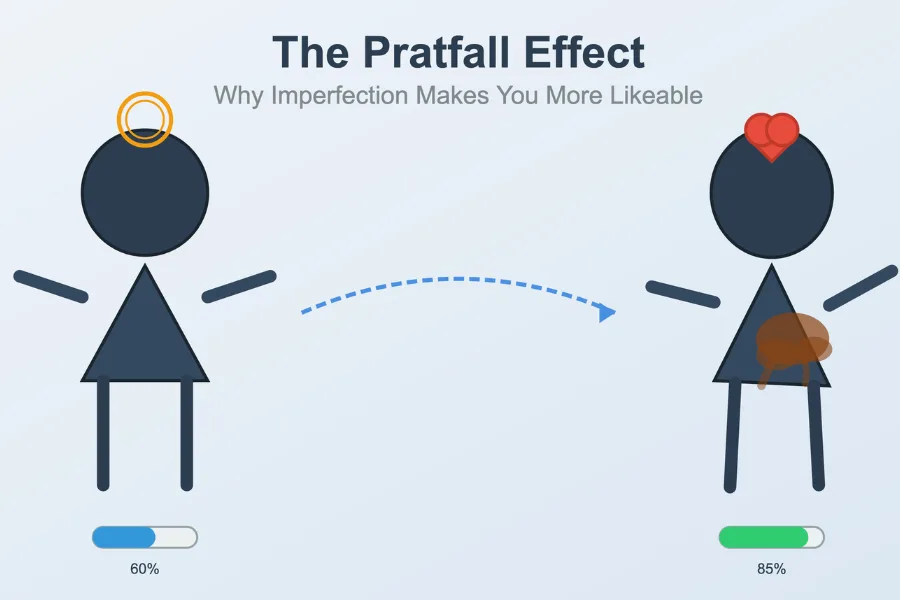
Have you ever noticed how someone who appears exceptionally talented becomes even more relatable after making a small, embarrassing mistake? Perhaps a confident speaker forgets a word, a highly skilled colleague makes a silly error, or a successful person laughs at their own awkward moment.
Interestingly, this behaviour is connected to a psychological concept known as the Pratfall Effect. It explores how showing imperfections can influence the way others perceive and connect with us.
What Is the Pratfall Effect?
The Pratfall Effect is a social psychology concept suggesting that a highly competent person may become more likeable after making a minor mistake.
The concept was introduced through a 1966 experiment by psychologists Elliot Aronson, Ben Willerman and Joanne Floyd. Their research examined how a person’s perceived competence and a clumsy mistake could influence interpersonal attraction.
The basic idea is that people who appear almost perfect can sometimes seem distant or difficult to relate to. A small, harmless mistake may make them appear more human and approachable.
However, the effect does not mean that every mistake makes someone more likeable. Context and perceived competence matter.
The Famous Coffee-Spilling Experiment
In the original experiment, participants listened to recordings of a student answering questions during a quiz competition.
Some recordings presented the student as highly competent, while others showed an average performance. In certain recordings, participants also heard the student accidentally spill coffee on himself.
The researchers examined how these different situations influenced participants’ impressions.
The findings suggested that a blunder could affect how people viewed someone differently depending on their perceived competence. A mistake did not automatically improve someone’s image, particularly when the person was already seen as an average performer.
This experiment helped establish the Pratfall Effect as an interesting concept in social psychology.
Why Do Imperfections Make People More Likeable?
Several psychological factors may help explain why acknowledging small mistakes can improve social connections.
1. Imperfections Make You Relatable
People often find it easier to connect with someone who experiences ordinary human struggles. Showing that you are not perfect can make interactions feel more natural and comfortable.
2. It Reduces the Pressure of Perfection
Someone who constantly tries to appear flawless may unintentionally create distance. A little vulnerability can make others feel less intimidated and more comfortable around them.
3. It Can Communicate Confidence
Acknowledging a harmless mistake without becoming defensive can suggest that you are comfortable with yourself. It shows that your confidence does not depend entirely on maintaining a perfect image.
4. It Encourages Authentic Connections
Being open about minor imperfections can create opportunities for humour, honest conversations and mutual understanding. People may feel more comfortable expressing themselves when they do not believe perfection is expected.
Does Showing Your Flaws Always Make You Likeable?
Not necessarily. The Pratfall Effect should not be treated as a universal rule.
A minor mistake made by someone respected for their abilities may be perceived differently from repeated errors by someone who has not established credibility.
The nature of the mistake also matters. A harmless awkward moment is very different from irresponsible behaviour, dishonesty or a serious professional failure.
Research on the concept has also produced mixed findings, so its effects should be understood with caution rather than treated as a guaranteed social strategy.
How to Apply the Pratfall Effect in Everyday Life
You do not need to deliberately make mistakes to become more likeable. Instead, try these simple approaches:
- Admit minor mistakes instead of making excuses.
- Laugh at harmless awkward moments when appropriate.
- Avoid pretending to know everything.
- Accept constructive feedback without becoming defensive.
- Share genuine experiences rather than presenting an unrealistic image.
Embrace Being Human
The Pratfall Effect offers an interesting reminder that perfection is not always necessary for building positive relationships. Competence, confidence and authenticity can work together to make interactions more meaningful.
Rather than constantly trying to hide every small imperfection, allow yourself to be human. Sometimes, the moments that make you appear less than perfect can make you easier to connect with.